
Context Engineering for AI Agents: How to Give AI the Right Information
Learn how context engineering helps AI agents use the right instructions, knowledge, tools, memory, and project context to produce more reliable results.
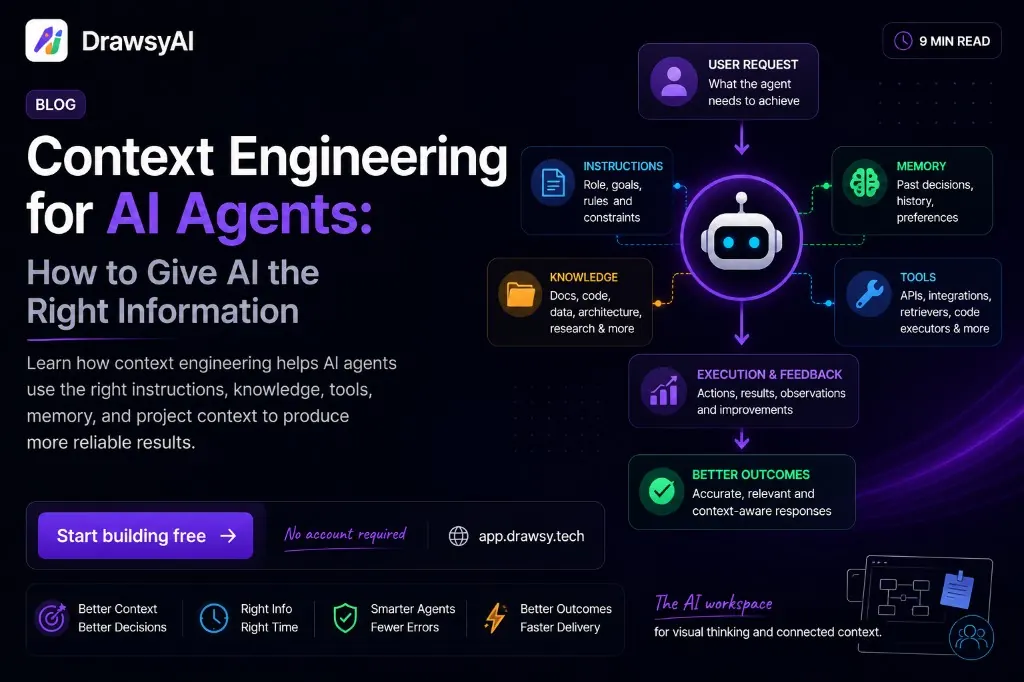
Why agent quality starts with context
AI agents are getting better at reasoning, using tools, and completing multi-step tasks. But there is a problem that becomes more obvious as agents move beyond simple chat:
An agent can only work with the context it has.
Give it the wrong files, stale documentation, incomplete requirements, irrelevant conversation history, or poorly structured tool output, and a capable model can still make the wrong decision.
That is where context engineering comes in.
Context engineering is the practice of designing the information an AI system receives so it has the right information, in the right form, at the right time. For an AI agent, that can include instructions, retrieved knowledge, conversation history, tools, tool results, memory, project state, and constraints.
The goal isn't to give an agent more context. It's to give it better context.
What is context engineering?
Context engineering is the process of deciding what information an AI agent should receive, how that information should be structured, and when it should be provided.
A simple agent might look like:
What a real project agent needs
A useful agent working on a real project often needs much more than a single prompt. The model is only one part of this system — the surrounding information determines what it can actually reason about.
Context engineering vs prompt engineering
Prompt engineering usually focuses on how you phrase instructions to a model — for example, “Review this function and explain the bug.”
Context engineering asks a larger question: What should the model know before it reviews the function?
Maybe it needs the relevant source files, the function's callers, database schema, API contracts, existing tests, recent changes, architecture decisions, error logs, project conventions, and the user's actual goal.
Prompt engineering still matters. But for agents that operate across multiple steps, the context pipeline becomes part of the system design.
| Prompt engineering | Context engineering |
|---|---|
| How should I instruct the model? | What should the model know? |
| Focuses on instructions | Focuses on the information environment |
| Usually one interaction | Can span an entire workflow |
| Prompt wording | Retrieval, memory, tools, state and instructions |
| "What should I ask?" | "What should the agent have access to?" |
Why context matters more for AI agents
A chatbot can sometimes answer a question with general knowledge. An agent is different. It may have to understand a goal, inspect information, choose a tool, perform an action, inspect the result, update its plan, act again, and validate the outcome. Every step creates or consumes context.
Consider a coding agent asked: “Add authentication to the application.” That request is nowhere near enough information to safely implement the feature.
The agent may need to understand the repository layout — frontend, backend, database, authentication, API routes, tests, environment configuration, and deployment — plus which auth provider is already used, how users and sessions work, which routes are protected, existing security conventions, deployment constraints, and previous architecture decisions.
Without that context, the agent can produce code that looks reasonable while being wrong for the actual system. This is exactly why AI coding agents fail when they only see a truncated slice of the codebase.
The five useful layers of agent context
There isn't one universal context architecture for every agent. But a useful way to think about the problem is through several layers.
1. Instructions
These establish what the agent is supposed to do: role, task, constraints, output format, safety requirements, and project rules.
For a coding agent, instructions might look like:
Follow the existing TypeScript conventions.
Do not introduce a new authentication library.
Run the existing test suite after changes.
Do not modify database migrations unless required.- These instructions establish boundaries — not the full project truth.
2. Knowledge
Knowledge gives the agent information about the world or project: documentation, databases, repositories, APIs, files, knowledge bases, search, and retrieved documents.
The important part is relevance. Dumping an entire knowledge base into a context window doesn't automatically make an agent smarter. The system needs to identify what matters for the current task — the heart of connected context.
3. State and memory
Agents often need information that persists across interactions — for example, a prior decision to use PostgreSQL because analytics already depends on it.
That decision can be much more valuable to a future agent than another generic explanation of PostgreSQL. Memory therefore isn't simply “remember everything.” Good memory preserves information that remains useful.
Previous decision
Use PostgreSQL rather than MongoDB.
Reason
Existing analytics infrastructure already depends on PostgreSQL.
Impact
New features should use the existing database layer.
4. Tools
An agent may have access to GitHub, databases, APIs, file systems, browsers, terminals, deployment systems, or observability tools.
Tool access creates another context problem. The agent needs to understand what the tool does, when to use it, what inputs it accepts, what its output means, and what permissions it has. A powerful tool with poor context can still produce poor results.
5. Execution feedback
An agent also learns from what happens after it acts. Test failures, error logs, and validation results become part of the working context for the next step.
This is one reason long-running agents require more deliberate context management than simple chat interactions.
More context isn't always better
This is one of the most important ideas in context engineering.
Imagine asking an AI coding agent to fix a login bug and giving it the entire repository, every GitHub issue, every Slack message, all logs from the last year, every deployment, the entire documentation site, and hundreds of previous conversations. Technically, the agent has more context. Practically, it may have a harder problem.
Some of that information is irrelevant, stale, contradictory, duplicated, noisy, or expensive to process.
A better system might retrieve the login service, authentication middleware, relevant database model, recent auth-related commit, failing test, and current error log. That is a smaller context — and much more useful.
This is why context engineering is not simply about increasing the context window. It is about selecting and structuring the right context.
Context engineering for coding agents
Coding agents make this problem especially visible because software systems contain a huge amount of implicit context.
A developer might know: “We don't use that service here because it caused a race condition two years ago.” That knowledge may live only in an old pull request, a design document, a Slack conversation, a code comment, or a teammate's memory. The code itself may not explain the decision.
An AI agent looking only at the current files can therefore miss an important constraint. A stronger coding-agent context might look like:
- The goal is not to expose the entire history of a project.
- The goal is to expose the history that explains the current system.
A practical context-engineering workflow
If you're building an AI agent today, start with the task rather than the model.
Step 1 — Define the task
What exactly is the agent trying to accomplish?
Bad: “Improve the application.” Better: “Add pagination to the `/api/projects` endpoint without changing the existing response shape.”
Step 2 — Identify required context
Ask: What would an experienced engineer need to know before making this change?
API implementation
Database query
Existing response type
Frontend consumer
Tests
Pagination conventions
Step 3 — Retrieve only relevant information
Don't automatically load everything. Use semantic retrieval, keyword search, metadata filters, repository structure, dependency relationships, and task-specific routing.
Step 4 — Separate facts from instructions
This distinction makes context easier for an agent to interpret.
Facts
- API returns 20 projects
- Frontend expects
projectsarray
Constraints
- Do not break response shape
- Use existing DB abstraction
Task
Add cursor-based pagination
Step 5 — Preserve important decisions
When an architectural decision is important, record the decision, why it was made, what it affects, and what it replaces. This prevents future agents from repeatedly reconsidering already-settled decisions.
Step 6 — Validate the result
Context engineering doesn't end when the model generates an answer. For an engineering agent, plan → implement → test → inspect failures → update context → fix → validate. The validation result becomes part of the next decision.
A simple context architecture
For many AI applications, a useful starting point makes one thing obvious: context is a pipeline, not a text box.
How to know whether your context is good
Before sending context to an agent, ask five questions:
Is it relevant?
Does this information help with the current task?
Is it sufficient?
Does the agent have enough information to make the decision?
Is it current?
Could some of the information be outdated?
Is it consistent?
Are there conflicting instructions or sources?
Is it traceable?
Can you understand where an important piece of information came from? These questions are especially important for agents operating on real systems.
The future of AI agents may depend less on bigger prompts
As AI models become more capable, the interesting engineering problem increasingly shifts outward. Not only “How intelligent is the model?” but “What can the system give the model to work with?”
An agent with a strong model but poor context can still make bad decisions. An agent with strong context can often make much better use of the same underlying model.
That's why context engineering is becoming an important part of building reliable AI agents. The model matters. But the information environment around the model matters too.
Where AI workspaces fit
This is also where the idea of an AI workspace becomes interesting.
Instead of keeping ideas in one tool, documents in another, code in GitHub, decisions in Slack, diagrams on a whiteboard, and AI conversation in a chat window, a workspace can bring relevant pieces of that context together.
The goal isn't simply to give AI access to more information. It's to make the relationship between the information visible and useful.
For visual and software-development workflows, that can mean connecting idea → architecture → documentation → code → decisions → AI → implementation.
This is the direction Drawsy is exploring: an AI workspace where visual thinking, connected context, and collaboration can work together rather than living in completely separate places. You can try the canvas at https://drawsy.tech/canvas, or read how to start using Drawsy. Learn more about Drawsy agents when you want AI that works with the board — not beside it.
Final takeaway
Context engineering isn't about writing the perfect prompt. It's about designing the information environment around an AI system.
For an agent, that environment can include instructions, project knowledge, retrieved information, memory, tools, tool results, constraints, and execution feedback.
The goal is simple: Give the agent the information it needs, when it needs it, in a form it can use.
As agents take on longer and more complex tasks, that may become just as important as choosing the model itself.
See context in action
Bring your visual work and project context together in one workspace.
Related reading
- What Is Context Engineering?Canonical definition of context engineering as a discipline.
- What Are AI Coding Agents?How coding agents use repository and project context.
- What Is an AI Workspace?Where visual work, context, and AI stay together.
- What Is Connected Context?Why linking tools and decisions matters for grounded AI.